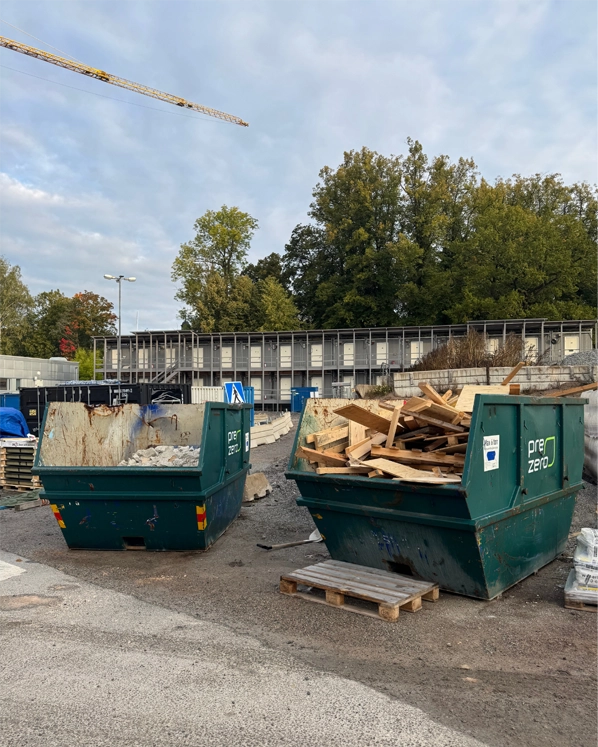
Sustainability in construction projects doesn't start in the report – it starts in logistics
Many construction projects have high sustainability ambitions. But real impact isn't created when numbers need to be reported. It's created in how deliveries are planned, how resources are used and how waste is managed every day. That's why sustainability in practice often starts with logistics.
Sustainability is today an obvious part of the construction industry's future. It's about climate goals, resource efficiency, circular flows and greater responsibility throughout the entire project chain. Yet many sustainability discussions get stuck at a general level.
People talk about goals. People talk about requirements. People talk about reporting.
But the real question is often simpler than that: How does everyday work on the construction site actually function?
Because that's where much of sustainability is actually determined.
Sustainability is not just a strategy – it's a way of working
When logistics functions poorly, the same types of consequences often arise:
- Deliveries arrive without clear management
- Materials are handled multiple times unnecessarily
- Resources are used inefficiently
- Waste is sorted or followed up too late
- Transports occur without sufficient coordination
- The project has limited overview of its own flow
This doesn't just create frustration and lost time. It also creates unnecessary carbon footprint, higher costs and fewer opportunities to make better decisions.
Sustainability must therefore start earlier than in the finished report. It must start in the planning.
Why logistics is a sustainability issue
Construction logistics is fundamentally about getting the right thing to the right place at the right time in the right way. When it works, flow is created in production. When it doesn't work, friction occurs.
And that friction costs more than many think.
- Unnecessary transports mean higher emissions
- Poor foresight creates more emergency solutions
- Lack of control over waste makes improvement difficult
- Double handling of materials creates both waste and time loss
This means logistics is not just an operational issue. It is also directly linked to the project's sustainability work.
The better the structure in the flows, the better the conditions for reducing resource waste and climate impact.
From ambition to follow-up
One of the most common problems in sustainability work is that it becomes difficult to follow up in practice. There are ambitions, but the data becomes too weak or too late.
This is where digitalization plays an important role.
When construction projects gain better control over delivery flows, transport patterns and waste, it also becomes easier to follow up on what actually happens. Then sustainability is not an afterthought, but part of the project's ongoing management.
This creates several advantages:
Clearer data – The project gains better visibility into how flows look and where improvement potential exists.
Faster improvements – When deviations are discovered in time, adjustments can be made during the project, not only when everything is already finished.
Greater credibility – Sustainability work becomes stronger when it can be demonstrated with actual figures and concrete follow-up.
Better collaboration – When multiple actors work with the same structure, the opportunity to create joint improvements also increases.
Sustainability doesn't require more documents – it requires better flows
Many organizations are used to thinking of sustainability as something that is documented. But the projects that succeed best work differently.
They build sustainability into everyday operations.
- They create clearer delivery management
- They reduce unnecessary transports
- They plan material flows more smartly
- They follow up waste and resources continuously
- They use data to improve, not just to report
That's where the real difference occurs.
Because sustainability in practice is rarely a matter of big words. It's a matter of thousands of small decisions that together shape the project's results.
Where Projsite creates value
Projsite helps construction projects make logistics more transparent, coordinated and trackable. When delivery planning, resource management and sustainability data become part of the same workflow, the project gets better opportunities to both manage and improve.
This makes it easier to:
- Plan smarter
- Reduce unnecessary waste
- Create better order in deliveries
- Follow up transports and waste
- Connect sustainability closer to daily operations
And that is important in 2026.
As requirements from customers, investors and the industry tighten, sustainability will not only be assessed based on goals. It will be assessed based on the ability to actually deliver.
A stronger construction industry starts with better structure
The construction industry faces great opportunities, but also high demands. To meet them, projects need not only ambitions — they need ways of working that hold up.
That's why sustainability cannot be treated as a separate track. It must connect with planning, production and logistics.
When logistics improves, sustainability becomes more concrete. When structure becomes stronger, improvements become possible to follow up. And when everyday flows work better, results also improve — for both the project and the world around it.
Sustainability in construction projects doesn't start in a final document. It starts in how work is actually organized every day. That's why better logistics is not just an efficiency issue. It's a future issue.
Want to create better control over both logistics and sustainability follow-up in your projects? Contact Projsite and see how a smarter way of working can make a difference in practice.